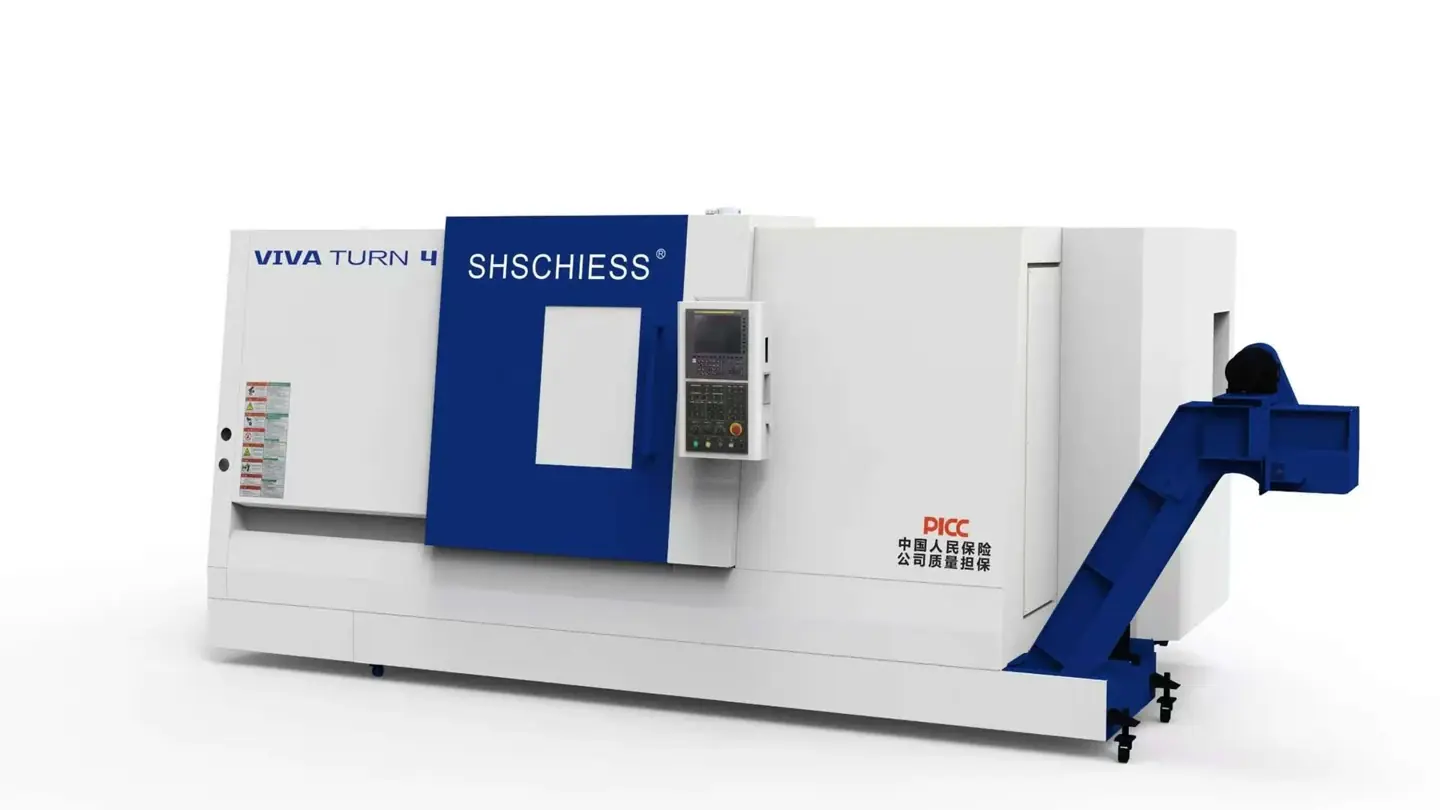
Representative series image. Configuration and enclosure may vary.
CNC TURNING CENTRES
T4/1000
FANUC-controlled turning with a 12-station turret, an A2-8 spindle and a 1000 mm cutting length.
Configured to order. Final specification, delivery and pricing are confirmed in your quotation.
TECHNICAL PROFILE
The details
that matter.
Reference configuration from manufacturer technical documentation. Options and document editions can differ; agree the exact configuration before ordering.
| Parameter | Specification | Unit |
|---|---|---|
| Swing over bed | Ø720 | mm |
| Maximum turning diameter | Ø630 | mm |
| Maximum cutting length | 1000 | mm |
| Swing over saddle | Ø500 | mm |
| Spindle nose | A2-8 | |
| Spindle bore | Ø80 | mm |
| Bar capacity | Ø66 | mm |
| X rapid traverse | 30 | m/min |
| Z rapid traverse | 30 | m/min |
| X-axis travel | 315 | mm |
| Z-axis travel | 1070 | mm |
| Tailstock travel | 850 | mm |
| Tailstock quill diameter | Ø120 | mm |
| Tailstock quill travel | 150 | mm |
| Machine weight | 7500 | kg |
| Machine dimensions (L × W × H) | 4550X2270X2100 | mm |
| Spindle speed range | 50–3,000 | rpm |
| Turret | 12 stations | |
| Control in reference configuration | FANUC 0i-TF |
FROM SPECIFICATION TO PRODUCTION
Let your component
lead the conversation.
Share the workpiece
Send material, dimensions, drawings and your required tolerances.
Define the process
Review workholding, tooling, spindle speed and control requirements.
Confirm the configuration
Agree a technical proposal, acceptance criteria and delivery schedule.
CONFIGURATION IN CONTEXT
Planning with T4/1000.
Start with cutting capacity
Check finished diameter and cutting length together. Swing over the bed describes clearance, while tool position, chuck jaws and the turret can restrict the actual machining envelope.
Choose the workholding route
For bar work, confirm spindle bore, drawtube clearance and feeder compatibility. For long shafts, review tailstock support, centre distance and the effect of slenderness before selecting a bed length.
Specify each operation
List facing, roughing, finishing, boring and threading. Milling or cross-drilling requires a separately confirmed driven-tool and axis configuration; these functions are not implied by a standard turning-centre listing.
T4/1000 or T4/1500?
These are published differences between the reference configurations. They help narrow a shortlist; they do not establish interchangeable tooling or identical performance.
| Parameter | T4/1000 | T4/1500 |
|---|---|---|
| Maximum cutting length | 1000 mm | 1500 mm |
| Z-axis travel | 1070 mm | 1570 mm |
| Tailstock travel | 850 mm | 1200 mm |
| Machine weight | 7500 kg | 9500 kg |
PRACTICAL ANSWERS
T4/1000 FAQ
What is the swing over bed of T4/1000?
T4/1000 lists Ø720 mm for swing over bed in the reference configuration. Confirm this value in the order-specific technical agreement and check tooling and workholding clearance.
What is the maximum turning diameter of T4/1000?
T4/1000 lists Ø630 mm for maximum turning diameter in the reference configuration. Confirm this value in the order-specific technical agreement and check tooling and workholding clearance.
What is the maximum cutting length of T4/1000?
T4/1000 lists 1000 mm for maximum cutting length in the reference configuration. Confirm this value in the order-specific technical agreement and check tooling and workholding clearance.
What should I compare with T4/1000?
T4/1500 is another model in this machine family. Review the differences above and both specification tables against the same drawing, tooling and installation requirements.
What is the price and delivery time for T4/1000?
This machine is configured to order. Send your controller preference, workpiece details, accessories and delivery destination so the team can confirm a complete quotation and production schedule.
How will T4/1000 be inspected before acceptance?
Agree the supplied configuration, geometric checks, sample machining and measurement method before ordering. Factory pre-acceptance and acceptance after installation should use the agreed technical requirements. See our quality and acceptance guide for the inspection planning process.
YOUR NEXT PRODUCTION CHAPTER
Let’s build what
comes next.
Start with your component, material and production target. We will help define the machine configuration.
Discuss your project